Growing Up Trellises

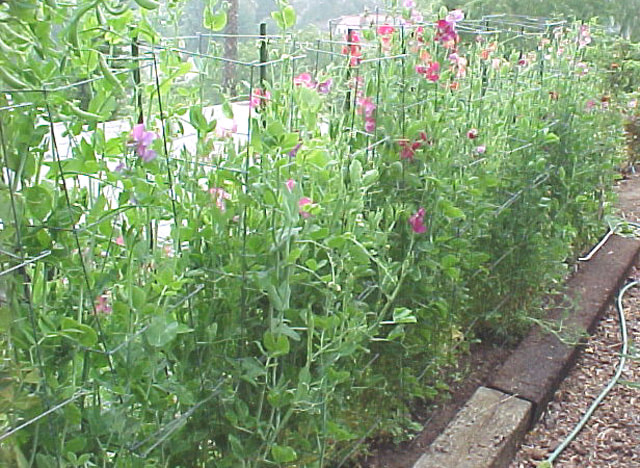
Sweet peas trellised up support vigorous vines. Pick blossoms frequently for increased blooming.
Cantalopes growing up trellis with melon in a pantyhose tied to the trellis to support its increasing weight as it matures.
Short cages are perfect fit for bush beans.
“A” frame trellises enable easy harvesting because the fruits hang down away from hiding in the foliage.
One-year-old boysenberry canes are pulled to the top of 3 horizontal wires strung between endposts, and anchored with closepins. Shorter canes are clothespined to bottom wires. Sideshoots produce the blossoms and berries.
Berries bear about Mother’s Day. To determine which are ripe, “tickle” each from from underneath on fruit that has turned from shiny to matte; if it falls into your hand, it’s ripe; if it doesn’t, it’s not yet fully ripe and will still be tart.
Tomato branches are well supported in cage trellises with both upright stakes at each cage and horizontal stakes anchoring the entire row.
Trellis and watering bucket setup.
Mini roses.
Mesembryanthemum groundcover and fragrant freesias.
Brilliant epiphyllum.
“Shredded white brugmansia.
Charles Grimaldi golden orange brugmansia is super fragrant at dusk.
Pink Ice brugmansia.
Attractive blossoms on Monarch Butterfly attractant plant.
Bougainvillea.
Cane begonia blossom.
First lily blossom.
    Trellises provide support for greater fruit production per square foot of soil and for longer periods because more leaf area is exposed to sunlight for more effective photosynthesis, and more air circulation means less fruit rot and ground-insect attack. Vines spreading on a trellis can also provide shade for a porch, patio, or wall. Crops grown on a trellis are easier to pick and cleaner, not available to snails and slugs, and not prone to ground rot.  Some vines need more guidance and anchoring onto the trellis than others, but all will grow well with proper fertilization and irrigation.

Heavy Fruit
Support heavy fruits on shelving, in netting, or with rags or old nylons. If left unsupported, their weight will drag the vines down from the trellis.

Short cages
Short cages originally marketed for tomatoes are perfect for shorter plants like 2-foot-tall flowers, bush beans, peppers and eggplants.

“A” Structure
A six-foot-tall structure in the shape of an “A” is especially helpful for harvesting fruits on that hang down, like pole beans and cucumbers, since the fruits are so much easier to see than “lost” somewhere in bushy plant foliage.

Cane Berries
Spread upright berry canes evenly along the trellis wire for good airflow of developing foliage that’ll bear blossoms and fruit.  At the top of the trellis wire, prune strong new canes to a foot to redirect growth to fruiting sideshoots instead of even longer main vines.

Tomatoes
    “Determinant” varieties will grow to 3 or 4 feet tall so one 5-6-foot trellis will usually suffice.
    “Indeterminant” varieties may extend to 8 or 10 feet high, so I stack a second trellis on top of the first one.

Upright and Horizontal Stakes
    To anchor a long row of trellised plants, I stake one corner of each trellis with an upright stakes and then tie in additional ones horizontally at the top of each trellis and stretching along the whole batch.  
    This technique effectively sturdies the entire row of plants as they develop through the summer, and it’s especially helpful later in the summer and fall when the plants are huge and full of heavy fruit.  I’ve done this ever since the year that the Santa Ana winds blew down my whole row of plants following my deep watering.

CATEGORIES:

Tags:

No Responses

Leave a Reply

Your email address will not be published. Required fields are marked *